Homeowners and property managers often stare at a cracked, faded, or worn driveway or parking lot and wonder whether they need to tear everything out. The good news is that in many cases, you can place new asphalt over old asphalt and restore a smooth, durable surface without the full disruption of complete removal. A professional pavement evaluation from Pave Chicago can help property owners understand the condition of their existing surface before choosing the right approach. The key is knowing when this method works and when it only delays a bigger problem.
This guide explains when placing new material over existing pavement makes sense, how the process works, and what Chicago’s climate demands. It also compares the main factors that determine whether an overlay or full replacement is more appropriate for a particular property. By the end, you will understand how pavement condition, drainage, structural stability, and site requirements affect long-term performance, helping you make a confident and informed choice.
Understanding the Process of Placing New Asphalt Over Existing Pavement
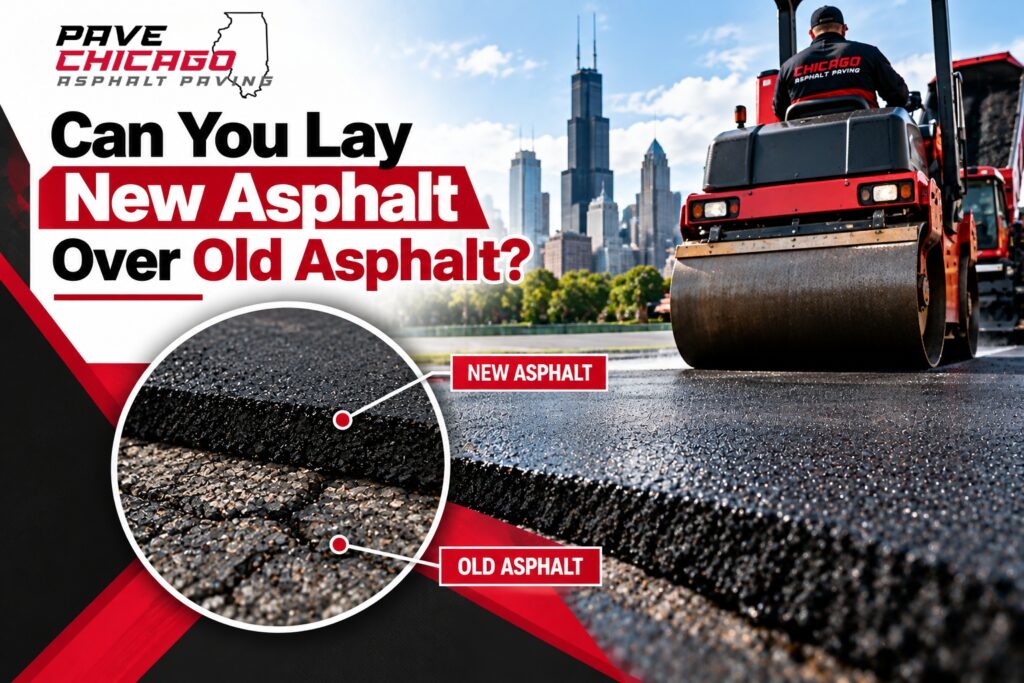
Placing a fresh layer of asphalt on top of an existing surface is commonly known as an asphalt overlay or asphalt resurfacing. The existing pavement stays in place and serves as the foundation for the new material. The thickness of the new asphalt layer depends on factors such as the existing pavement condition, expected traffic, site elevations, and project requirements.
The process usually begins with a thorough evaluation of the current pavement. Crews identify and repair isolated problem areas such as potholes or soft spots. In many projects, the top portion of the old surface is milled or ground down slightly to create a clean, level plane and to maintain proper elevations at transitions. A tack coat—an adhesive emulsion—is then applied so the new asphalt bonds securely to the old surface. Finally, the new mix is placed, spread, and compacted to the specified thickness and density.
When the underlying structure is sound, this method reuses the existing asphalt as a stable base. The result can provide a smooth, renewed surface while avoiding some of the disruption associated with full reconstruction.
When New Asphalt Over Old Asphalt Works Well
An asphalt overlay succeeds when the existing pavement still provides solid structural support. Ideal candidates share several characteristics:
The base and subgrade remain stable with no widespread soft spots or pumping under load. Cracking is limited and mostly surface-level rather than extensive alligator or fatigue cracking. Edges hold their shape without significant crumbling or failure. Drainage already slopes correctly so water does not pond. Fixed elevations at garage floors, sidewalks, curbs, and street connections allow enough room for the added thickness without creating tripping hazards or drainage problems.
In these conditions, the new layer can help restore smoothness and appearance while covering surface-level wear. Many driveways and parking lots that look tired on the surface can still be suitable for asphalt resurfacing when the underlying pavement remains stable and structural problems are limited.
Consider a hypothetical Chicago residential driveway that is 15–20 years old. The surface shows scattered hairline cracks and some fading from years of sun and salt, yet the edges remain firm and water drains cleanly toward the street after a heavy rain. When walked on, the pavement feels solid with no soft or spongy areas. In this situation, an overlay could provide a smooth, renewed surface while the existing pavement continues to provide structural support.
When You Should Avoid Laying New Asphalt Over Old Asphalt
Not every pavement is a candidate. Certain problems can make an overlay a short-term solution that does not address the underlying cause. When the base has lost its load-bearing capacity, water is trapped in the structure, or elevations leave no room for additional thickness, simply placing new asphalt over old asphalt may not address the underlying problems, making full removal and replacement more appropriate.
A clear comparison helps illustrate the decision:
| Base stability | Sound and uniform | Soft spots, settlement, or pumping |
| Cracking pattern | Limited linear or isolated cracks | Widespread alligator cracking |
| Drainage | Proper slope already present | Standing water or poor grade |
| Edge condition | Intact | Significant raveling or failure |
| Previous overlays | None or one thin layer | Multiple layers already present |
| Elevation at transitions | Adequate clearance | Insufficient height at garage, sidewalk, or street |
If several replacement indicators appear across a large portion of the surface, the existing structural problems are more likely to affect the performance of a new overlay.
How Chicago’s Climate Affects the Decision
Chicago’s freeze-thaw cycles, road salt, and heavy winter traffic place extra stress on asphalt. Water that seeps into cracks expands when it freezes, widening the openings and weakening the base. Repeated cycles accelerate reflective cracking—the process in which old cracks eventually show through a new surface. Salt and plow blades further attack the surface and edges.
Chicago’s seasonal temperature changes and winter conditions make careful pavement evaluation important when considering an asphalt overlay. Existing weaknesses can affect how well an overlay performs over time, which is why the condition of the underlying pavement should be assessed before installation.
The resurfacing guidance from Pave Chicago emphasizes evaluating pavement condition, checking drainage, addressing damaged areas, and properly preparing the existing surface before installing a new asphalt layer. These factors help determine whether resurfacing is appropriate or whether more extensive pavement work is needed.
Pros and Cons of an Asphalt Overlay
An asphalt overlay offers clear advantages when conditions allow it. Installation is faster and less disruptive than full removal. The finished surface can provide a clean, uniform appearance, and an overlay may require less construction time and disruption than full removal and replacement, depending on the project.
Trade-offs exist, however. Reflective cracking can return sooner than with a completely new pavement. The base cannot be fully inspected or rebuilt, so hidden weaknesses remain. Elevations rise slightly, which must be managed at every fixed transition. The expected service life may also be more limited depending on the condition of the existing pavement.
Full replacement addresses the foundation completely. Soft spots can be undercut and rebuilt, drainage grades corrected, and edges properly formed. Full replacement allows underlying structural problems to be addressed and can provide a more predictable pavement structure when properly designed and installed. The higher upfront investment and longer construction time are the main drawbacks.
How Professionals Evaluate Your Pavement
A reliable assessment goes beyond a quick visual glance. A professional evaluation may consider crack patterns, soft spots, drainage, surface condition, elevations at critical transitions, and signs of previous overlays. Depending on the project, the pavement may also be evaluated for existing thickness and other structural conditions. This assessment helps determine whether the existing pavement can support new asphalt over old asphalt or whether more extensive reconstruction is needed.
Homeowners can perform a preliminary check by looking for extensive alligator cracking, recurring potholes in the same locations, persistent standing water or poor drainage, or edges that crumble underfoot. Any of these signs warrants a professional inspection before deciding on an overlay.
Maintenance After an Overlay or Replacement
Regardless of the method chosen, ongoing care extends pavement life. Periodic sealcoating, when appropriate for the pavement and climate, can help protect against oxidation and water intrusion. Prompt crack sealing prevents moisture from reaching the base. Keeping drainage paths clear and avoiding heavy point loads on the edges further reduces stress. These simple steps help both overlays and new installations reach their full potential through proper asphalt resurfacing care when needed.
Making the Right Choice for Your Property
Laying new asphalt over old asphalt can be an effective solution when the existing pavement remains structurally sound. It restores appearance and function while avoiding the disruption of full reconstruction. When the base has failed, drainage is poor, or elevations leave no room for added thickness, removal and replacement may be more appropriate.
Every property is different. The only reliable way to decide is a careful on-site evaluation that considers surface condition, base strength, drainage, and local climate stresses. If your driveway or parking area is showing wear, a professional assessment will clarify the best path forward and help you avoid costly short-term fixes.
For properties throughout Chicago and the surrounding suburbs, Pave Chicago offers pavement evaluations and recommendations based on site conditions. Contact the team to schedule an inspection and receive a detailed plan tailored to your pavement and budget. A well-informed decision can help you avoid unnecessary work and choose an approach that fits your property’s needs.